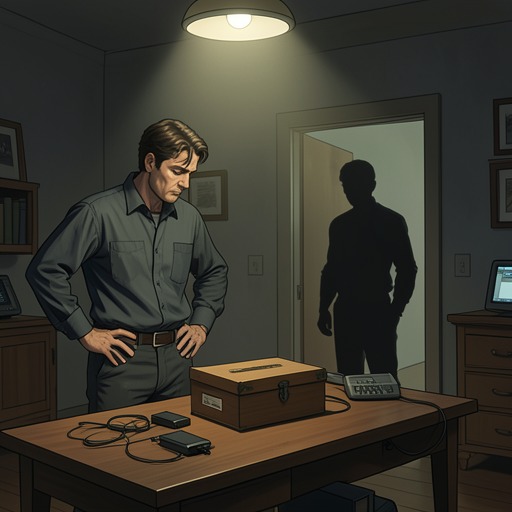
Box-man state
The Box ManThe Box-man state is a mode of life in which a cardboard enclosure becomes shelter, equipment, and a boundary between its inhabitant and the ordinary city. The narrator presents it not as a disguise that can be discarded at will, but as a condition that reshapes perception and daily routine. Its narrow observation window frames the outside world, while the box itself comes to signify both social exclusion and the possibility of passage elsewhere.
Definition and Construction
The account identifies itself as a record made from inside a box. The enclosure reaches the narrator’s hips when worn over the head, and its construction is simple enough to take less than an hour. The difficult step is not assembling it but putting it on and going out: in the narrator’s description, the wearer becomes an apparition that is neither simply a person nor simply a box. That ambiguous appearance gives the state its force. It marks its inhabitant as conspicuous and unsettling even as it conceals them.
The enclosure is also a working interior, arranged around a few indispensable belongings. Short lengths of wire bent into hooks hang items on the walls; the narrator names a radio, mug, thermos, flashlight, towel, and small bag among the basic possessions. Rubber boots must have no holes, while canvas wrapped around the waist helps hold the box in place and leaves room for movement and ordinary bodily needs. These practical details show that the box is not merely a symbol. It has to accommodate weather, storage, mobility, and the recurring tasks of living.
Social Position and Disorientation
The narrator distinguishes box men from vagrants, while acknowledging that society appears not to distinguish clearly between them. Both may lack identification, a profession, a fixed residence, a recorded name or age, and regular arrangements for meals and sleep. Yet the narrator describes a separate identity and reports hostility from beggars and vagrants, particularly in the Wappen beggars’ area. The distinction is therefore unstable: it matters to the box man, but it does not necessarily secure recognition from others. The narrator even allows that a box man may occupy a position lower than a beggar.
The state’s recurring psychological disturbance is described as a paralysis of the heart’s sense of direction. At such moments, the narrator feels the earth’s axis sway and experiences nausea like seasickness, but does not connect this response to guilt about being a social dropout. The box is not experienced as a moral failing. The narrator instead imagines it as an entrance to another world, while admitting that, from the observation window, that entrance can look little different from a dead-end alley. This tension preserves both the promise of escape and the constriction of the life that promises it.
Daily Practice and Improvised Equipment
Life inside the box depends on practical adaptation rather than complete withdrawal. The narrator’s possessions are pared down to what can serve a daily purpose, and even an ordinary plastic board acquires several uses. Sixteen by eighteen inches, it can act as a table, a surface for preparing food, a cover for the observation window in difficult weather, a fan when the air is still, a seat on wet ground, and a work surface for reusing cigarette tobacco. Its importance comes not from rarity but from the number of needs it answers in a life with little space and few possessions.
The narrator also describes a movement from accumulating objects toward learning what is genuinely useful. At first, the box held a miscellany kept on the assumption that it might someday come in handy. The later effort to reduce belongings reflects a different practical knowledge: life in the box requires selection, not simply concealment. Food gathering likewise brings the box man into busier parts of town. Although food can be obtained from store counters, searching for leftovers becomes a way to learn the city. The narrator remains unable to become accustomed to the mixed smells of discarded food, despite three years of life in the box; the routine solves a material problem without making its discomfort disappear.
The Box as Threshold
The narrator rejects the idea that taking off the box would amount to an uncomplicated return to the ordinary world. After three years, the box has become more than a covering: the narrator compares dependence on it to a hermit crab’s body changing under its shell and describes leaving it as an emergence into another world, like an insect’s transformation. A payment of fifty thousand yen, delivered with a letter, is judged too small to capture what the box means to its occupant. The narrator had secretly hoped that a meeting with the person who brought it would provide the occasion for leaving, but the hoped-for transition is not presented as something already accomplished.
A later episode brings that expectation into sharper focus. At the municipal seaside bathhouse facing the Port of T, the narrator has washed, shaved, and cleaned their clothes, then waits inside the box only until the clothing dries. They describe themselves as already halfway out and see an encounter with a girl as the opportunity anticipated for three years. Instead, they unexpectedly encounter a fake box man, their own replica, watching the girl. The sight prompts a blunt recognition that the narrator is already bored with the box and that a tunnel matters only if it has an exit. The scene makes departure seem imminent in the narrator’s thinking, but the planned transition remains a plan, not a confirmed outcome.
Time, Habit, and Narrative Meaning
The Box-man state also changes the narrator’s sense of time. Once accustomed to moving among crowds, the narrator describes time as forming concentric circles around the box man: the background races past, the foreground slows, and the center becomes still. This pattern turns a condition often associated with isolation into a particular way of inhabiting urban movement. The box man is not outside the city altogether; daily needs draw them through it, and familiarity makes those passages into a practiced routine.
That routine stands against the narrator’s own warning that the box can become an apparent dead end. The account’s close attention to hooks, boots, canvas, food, and the multipurpose board makes the state tangible as labor and adaptation, while its language of entrances, tunnels, shells, and transformation keeps open the possibility that this life might lead somewhere beyond itself. The narrator’s final contrast between the bored fake box man and the question of who has, or has not, become a box man unsettles any simple division between authentic inhabitant and imitation. The state is at once a concrete arrangement for survival and an uncertain identity whose boundaries the narrative continues to test.